
BigLaw firms are billing more hours at higher rates, while clients are pressing firms for lower costs and different pricing models due to AI efficiencies. Lower costs have not borne out, despite large A.I. investments by law firms (or perhaps because of it). Q2 demand was up 3% and worked rates were up 7.1% over Q2 2025 (Q2 Law Firm Financial Index Report, 8/10/26, Thomson Reuters); see also Big Law Firms See 'Rare' Demand Growth, but Expenses Accelerate, Andrew Maloney, 8/17/26, Law.com, noting finding of 4.2% demand growth during the first half of 2026 in Citi's Global Wealth at Work's Law Firm Group Report).
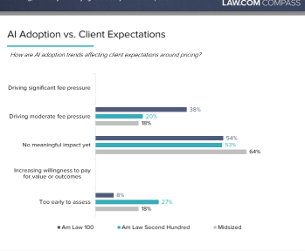
In a recent Law.com Compass survey, the majority of partners at AmLaw 100, Second 100, and Mid-size law firms reported that AI adoption had no meaningful impact to that point on client's expectations around pricing (Q2 2026 Law Firm Performance Survey, Law.com Compass, Dan Masopust, 8/5/26). That said a significant number reported moderate fee pressure from clients and no partners noted an increased willingness by clients to pay for AI enhanced value or outcomes, likely indicating that firms have much work to do in selling clients on that proposition.
However, change may be coming. In a recent LawVision survey of 75 law firm respondents, 11 firms had meaningfully revised their pricing in response to AI, and an additional 26 intended to integrate AI into their pricing processes during 2027." (These Am Law Firms Lead the Way on AFAs. Here's How AI and Data Collection Are Pushing More to Explore, Andrew Maloney, 8/26/26, Law.com). And the industry has recent experience in moving away from the billable hour model; since 2020, alternative fee arrangements have accounted for 16% to 17% of revenue at AmLaw 200 firms.
Mental Health
Attorney mental health researcher Patrick Krill published a study in conjunction with the ABA, which received survey responses from nearly 37,000 attorneys. In New Study, 41% of Attorneys Say Practicing Law is 'Detrimental' to Mental Health, Amanda O'Brien, 9/9/26, Laaw.com). Several key findings:
nearly half of those surveyed reported high or very high levels of burnout;
more than 40% reported clinically hazardous drinking habits;
attorneys younger than 30 years old reported higher levels of depression, anxiety and stress compared to their older counterparts.
moderate or higher depression was reported by 31.5% of the younger-than-30 cohort, compared to 9.7% amongst those age 61 or older; 40.4% of those under age 30 similarly reported symptoms of anxiety, compared to 6.2% of those over 61.
The study noted a "protective association with older age that was steep and consistent" that required further study to determine whether the difference was a result of “a healthy worker or survivor bias, cohort differences, differential attrition from practice, or career-stage effects."
Barriers to seeking help still exist in the legal industry. Mirroring the previous 2016 study, more than 50% raised confidentiality concerns, and nearly half raised concerns about their reputation or career progression.
Wells Fargo Survey
More good news from the first half of 2026. Correlating with both LFFI and Citi, Wells Fargo's Legal Specialty Goup's Six-month 2026 Survey found double-digit standard rate increases, and demand growth at 4.8%, more than double H1 2025's rate of 2.0% (See Increasing Demand and Rising Rates Boost Law Firm Revenues in H1, Tom Spigolon, 9/15/26, citing survey of more than 140 firms, including 69 Am Law 100 firms and 48 Second Hundred firms).
Revenues for the Am Law 200 also increased 12.4%, while collections declined largely due to work sitting in inventory; unbilled time inventory had increased 21.4% as of August.