A.I. and Write-offs; Raising Rates; 2026 Predictions
Much has been written about how AI might affect associate hours and ultimately law firm revenue. According to Thomson Reuters' 2026 Report on the State of the U.S. Legal Market ("State of the Market"), the answer may be not much, at least in the short-run, because associate time is already being written off. Associate realization averages 85.6%. According to Thomson Reuters, "this creates a buffer in which AI can absorb the inefficient portions without touching collected revenue. In this way, firms can automate the work that wasn’t getting paid for while keeping associates busy on higher-value tasks." While making intuitive sense, the premise begs two questions: 1) are there enough higher-value tasks to keep all associates busy? and 2) will clients expect write-offs for that time as well?
Raising Rates
Law.com published late last month its annual Attorney Compensation Survey, which includes self-reporting by attorneys of their rates as of Jan. 2026. Although the number of respondents may not be large enough to offer a complete picture, the relative increases from Jan. 2025 can be instructive.
The survey results reveal a 6.5% standard rate increase from Jan. 2025 to Jan. 2026 among equity partners, an 11.6% increase among non-equity partners, a 1.3% increase among associates, and a 6.5% increase among counsel. The Jan. 2026 increases build on substantial standard rate increases in 2025, which law firms were largely able to push through (See Law Firms Made Hay From 'World's Complexities' in 2025, Early Numbers Show, Andrew Maloney, Law.com, 2/11/26, noting Wells Fargo’s Legal Specialty Group's finding of an industry-wide 9.6% standard rate increase; see also State of the Market, noting worked rate growth for Am Law 100 firms through November of greater than 9%; 7% for Second Hundred firms; and 6% for Midsize Firms.
A recent Law.com article questioned whether law firms could continue to raise rates with impunity (Raising Billing Rates to Drive Profitability Is a Dead End for Law Firms, Jon Campisi, Law.com, 1/26/26). Rate increases have been the primary driver of AmLaw profits in recent years, and realization has dropped only minimally. In other words, firms are better off from having raised rates. Quick illustration: Law Firm has a 90% realization rate, collecting $900K on $1M in 2025. In 2026, Law Firm raises rates by 10% but realization drops 2% to 88%. Assuming demand stays constant, Law Firm collects $968K on $1.1M, resulting in a 68K increase in revenue. In fact, Law Firm's realization could drop 8% (all the way to 82%) and Law Firm would still increase revenue (though modestly). In short, rate hikes are asymmetric upside bets. Law Firm wins big if realization holds, and Law Firm still wins if it slips moderately.
2026 Predictions
The above calculation assumes that demand holds. Thomson Reuters predicts a small contraction in demand in Q2, Q3, Q4, relative to the demand surge experienced in 2025.
Further, Thomson Reuters' Net Spend Anticipation Survey ("NSA Survey") of General Counsels predicts a shift in spending, specifically double digit spend for "regulatory work" and countercyclical practices, and a decline in transactional spend. The NSA Survey also predicts spending increases in recession-proof sectors like pharma and healthcare but spending decreases in technology and telecom, "flatlining" legal spend in consumer-facing businesses, and a "sharply negative" turn in real estate development legal spend.
Although demand may shift, the jury is still out on whether overall demand will drop. Prior surges have preceded significant downturns but those surges "were tied to economic bubbles — excessive credit in 2007 and excessive stimulus in 2021"; whereas the 2025 demand surge resulted from "chaos - trade wars, regulatory upheaval, and geopolitical tensions – all of which require constant legal navigation" (State of the Market). And although instability may not be good for the economy, it may continue to be good for law firms (State of the Market, noting the 2025 demand drivers are not "cyclical phenomena that will simply reverse when the economy cools, rather they’re structural changes that could sustain legal demand even through a recession").
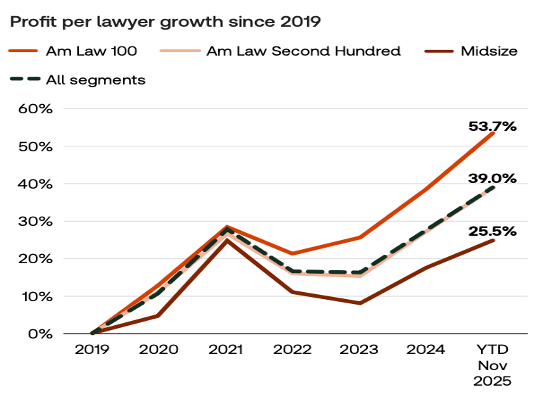
It is also important to recognize that demand contraction does not necessarily result in profit contraction. Rate increases can more than make up for declines in demand and/or realization. Moreover, longer-term profit trends are favorable. Since 2019, profit per lawyer has increased substantially across law firm segments (State of the Market).