
Q1 Performance; AmLaw 100 & 200; Mansfield Rule
Firms were able to grow rates substantially in Q1 2025, according to both Thomson Reuters' Q1 Law Firm Financial Index and Wells Fargo Legal Specialty Group's Q1 Survey, reporting average worked growth of 7.3% and average standard rate growth of 9.5%, respectively (Law Firm Financial Index Q1 2025 Executive Report “LFFI Report”, Thomson Reuters, 5/5/24 and Law Firm Demand Growth in Q1 Fell Short of Expectations: Report "WF Report", John Campisi, 4/29/25, American Lawyer).
Demand growth was minimal (.05%, LFFI Report; 1.7% WF Report). According to the LFFI Report, otherwise anemic demand was buoyed near the end of Q1 by a flood of client requests seeking to navigate shifting trade policy. Realization was up as well despite the rate increases, leading Thomson Reuters to observe: "as the fires of the global trade war spread, it seems clients had greater concerns than trying to bargain with the firefighters."
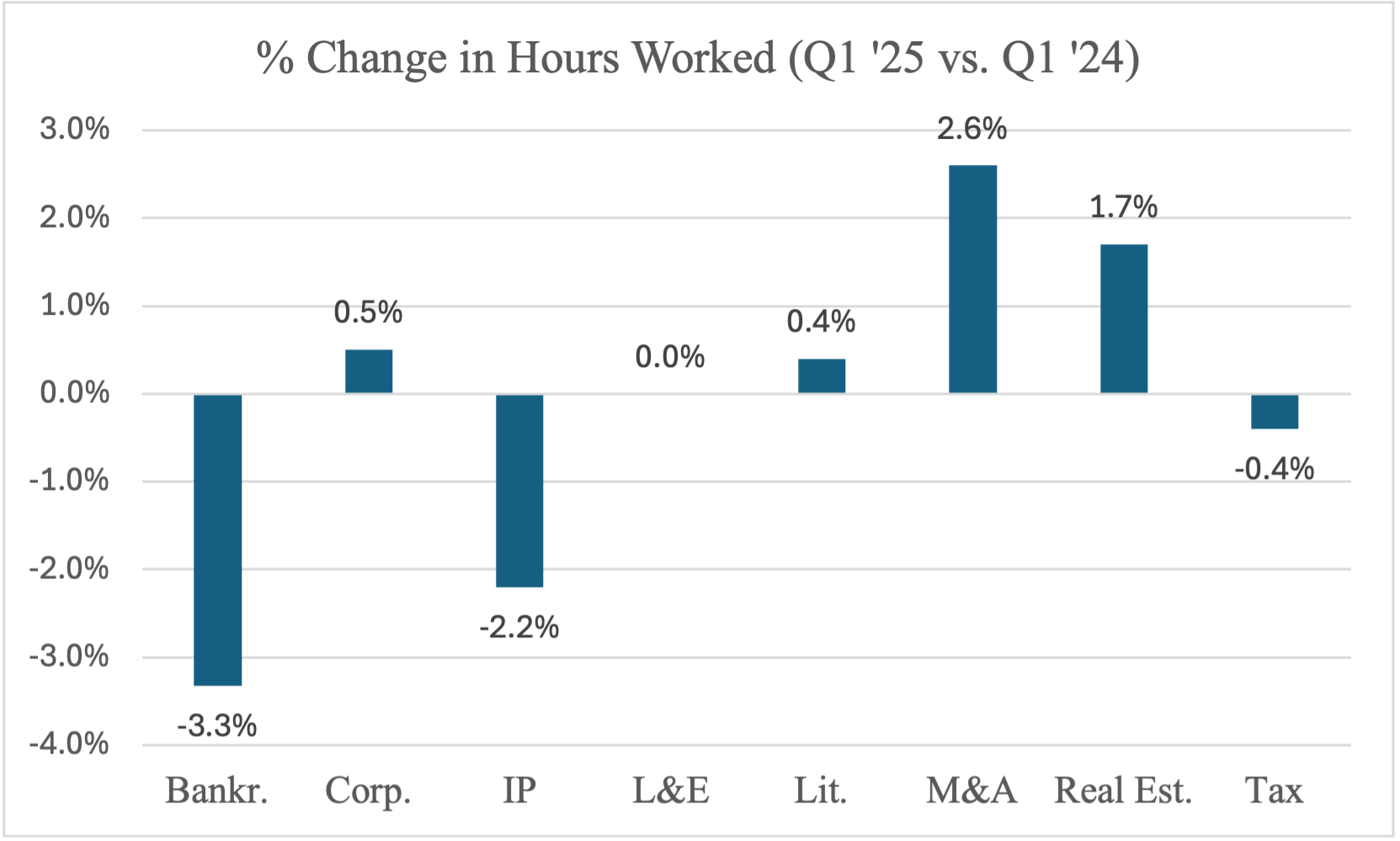
Firms have hired "briskly" so far this year, which may lead to utilization problems down the road (WF Report). In fact, average hours billed per lawyer decreased 1.6% across the Amlaw 200 (WF Report). Similarly, the LFFI Report noted a productivity decline of 2.4%, among the 170 U.S.-based firms that it tracks.
Uncertainty in economic and political spheres may continue to buttress demand for partner level counsel (at higher rates) for some time longer (as it did in the beginning of the Covid pandemic), leading to a potentially profitable 2025. Yet Thomson Reuters expressed concern for 2026 and beyond, noting that law firms scored well in the LFFI Report throughout 2007, despite the challenges that were to come with Great Financial Crisis in 2008.
AmLaw 100 & 200
The AmLaw 100 posted a 13.3% year-over-year increase in revenue in 2024 (How the Am Law 100's 'Bang-Up Year' Was Even Better Than Predicted, 4/15/25, Patrick Smith). 98 of the 100 firms reported across-the-board gains in gross revenue, revenue per lawyer, and partner compensation (Power Ranking the Am Law 100: Edge of Chaos, Jae Um, 4/15/25, American Lawyer). The Second Hundred posted 11.1% revenue growth in 2024, up significantly from a 5.9% increase in 2023 (The 2025 Am Law 200: Ranked By Gross Revenue "The Am Law 200", ALM Staff, 5/6/25, American Lawyer). Overall, fifty Am Law 100 firms and forty-seven Second Hundred firms posted double-digit revenue increases (The Am Law 200).
Mansfield Rule
The Mansfield Rule has played a significant role in lateral recruiting since 2017. Inspired by the NFL's Rooney Rule, Mansfield's goal is to broaden who is considered, not mandate who is hired, according to Diversity Lab founder and CEO Caryn Stacy whose organization created the Mansfield Rule. Over 365+ law firms in the US, Canada, and the U.K. are Mansfield certified in the 2024-25 cycle. I recently interviewed Diversity Lab's Caryn Stacy for NALSC's podcast Recruiter Stories. Caryn noted that firms are in the process of Mansfield re-certification, and at the time we spoke more firms had re-upped for the 2025-26 cycle than at the same point in 2024. The Mansfield Rule appears to have had an impact in the legal industry, as seen in the graphs below.
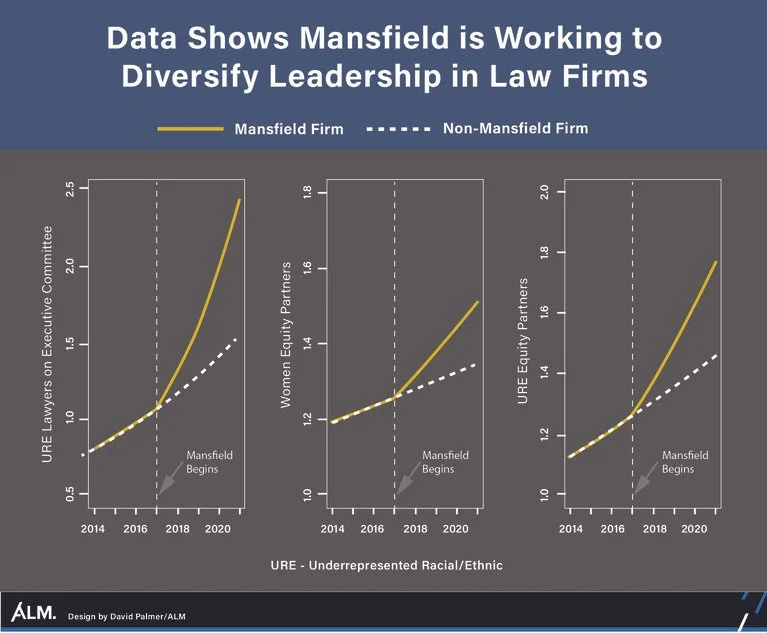
Mansfield has come up in recent hearings and filings in the Perkins Coie and Jenner & Block cases, with the DOJ citing law firms’ participation in Mansfield to buttress arguments that the firms engage in discriminatory employment activities (After DOJ Points to 'Problematic' Mansfield Purpose, Creators Cite Legal Framework, Abigail Adcox, 4/29/25, American Lawyer). On May 2nd, U.S. District Court Judge Beryl Howell ruled that the Executive Order targeting Perkins Coie is unconstitutional; although the legality of Mansfield was not at issue in the case, Judge Howell noted in the opinion that:
“the Mansfield Rule expressly does not establish any hiring quotas or other illegally discriminatory practices, requiring only that participating law firms consider attorneys from diverse backgrounds for certain positions;" and
"the principle underlying such programs is that negative biases against qualified underrepresented lawyers, due to their race, sex, gender identity, disability or ethnicity, reduce their likelihood of being selected as frequently to interview for positions for which they are qualified, but when firms consider more underrepresented talent on their own individual merit and not disadvantaged for the traits ‘unrelated to them as individuals,’ firms tend to hire more of these individuals on their own merit.”
You can learn more about the Mansfield Rule and Mansfield Certification here.