
Frothy Market; Hiding Partner Promotions; Vetting Client Portability
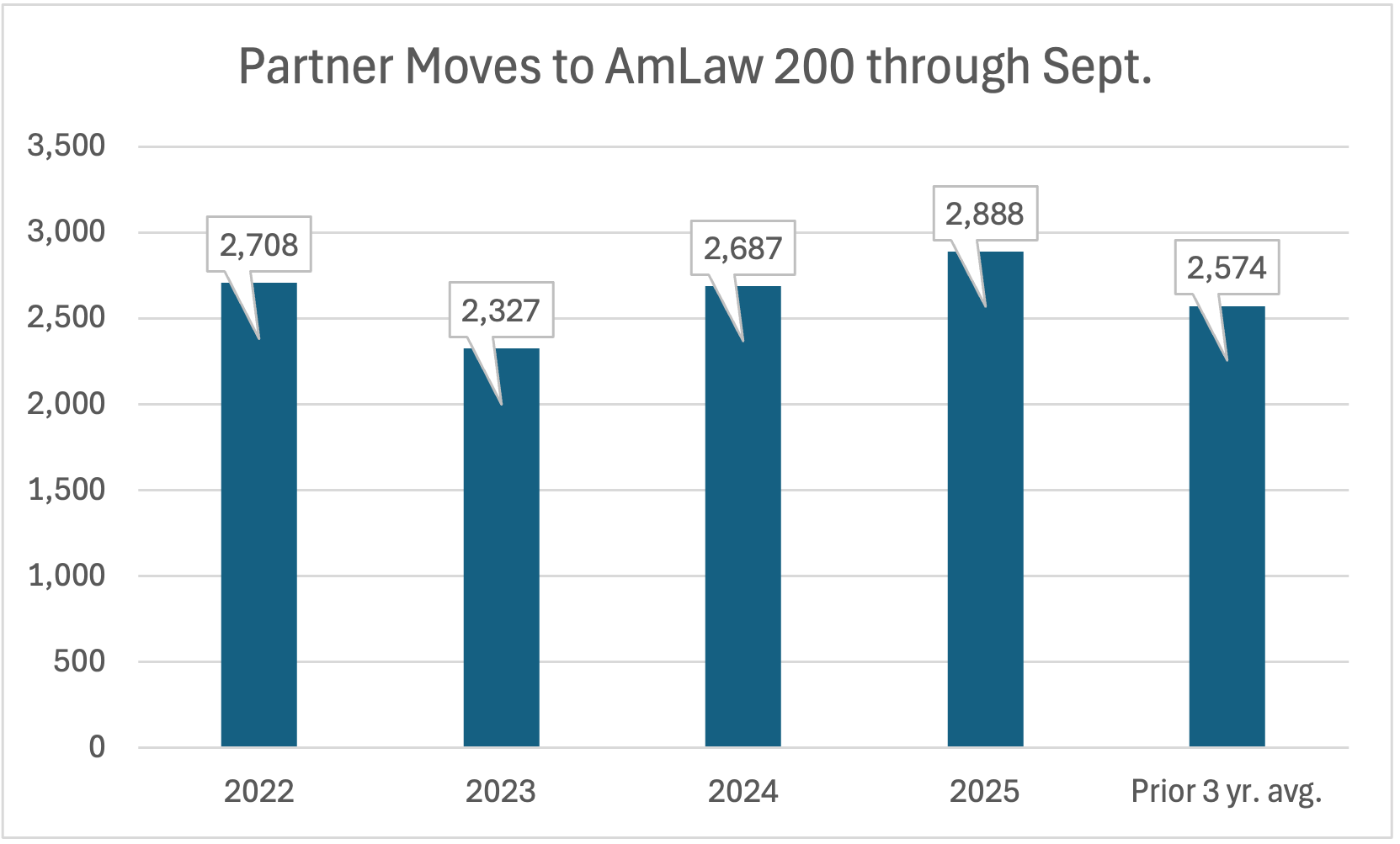
Big Law is doing quite well so far in 2025, despite economic uncertainty and adverse actions taken by the Trump Administration earlier this year (Big Law Firms Stay Profitable, and Quiet, During Second Trump Term, Christine Simmons, 9/25/25, Law.com). The lateral partner market has been active as well, with 2,888 lateral moves to AmLaw 200 firms through the month of September (data from Firm Prospects; see also As Lateral Moves Accelerate, Here's How Firm Leaders Are Navigating the 'Free Agency Model', Andrew Maloney, 9/24/25 Law.com). These moves eclipse the 2024 tally of 2,687 through the same period, as well as the prior 3 year average of 2,574.
Hiding Partner Promotions
A recent Law.com article discussed the marketability of newly promoted partners and the apparent strategy by some major law firms like Kirkland to not announce partner promotions publicly (In Big Law's 'Free-Agent' Era, Are New Partners 'Ripe' for Moves?, Andrew Maloney, 10/20/25, Law.com). Withholding announcements will do little to prevent the poaching of newly minted partners, to the extent those partners are otherwise attractive to recruiters and the firms that they recruit for. Recruiters subscribe to databases that scrape law firm websites daily for updates on attorney bios. These databases have robust attorney filter fields, through which recruiters can limit search results by firm, title, JD year, law school, practice area, bar admissions, etc. Several even have a specific status update field, with recent promotion to partner as one of the choices. In order to truly hide promotions, firms would need to remove titles from bio pages altogether, but even then recruiters could use JD year as a proxy and cross-reference with LinkedIn if desired.
Regardless, earning a partner title does not guarantee success on the lateral market. Absent less common circumstances where the hiring firm has work to fully occupy the lateral partner hire, the chief currency on the lateral market is a portable book of business. Contributors to the Law.com article admit as much when discussing the marketability of new promoted partners: “It just depends on their practice and what their book is.” Frankly, that could be said of any partner at any stage in their career. It also applies to any senior associate or counsel who has yet to be promoted but who also has a large book; with the caveat, that there will likely be more skepticism as to why their current firm has not yet promoted them, if their numbers are what they have represented in their LPQ. But that skepticism can be addressed through proper vetting.
Vetting Client Portability
Before making a lateral move, a partner must ask: Will my clients move with me? It’s the same question every prospective firm will ask. To assess portability, both the partner and the firm should explore questions in several key areas.
Client's Relationship with Current Firm
Who was the originator of the client relationship?
If not the lateral partner, is the originator still active in the relationship?
Who does the client call when a new problem arises?
Who manages the teams that work on the client's matters?
Are there any partners who could handle or manage the work, if the lateral partner left?
Do other partners at the lateral partner's current firm handle other work for the client, outside of the lateral partner's purported book?
Lateral Partner's Relationship with Client
How long has the lateral partner represented the client?
Who are the lateral partner's points of contact at the client? Is it one point of contact or several?
How influential are those contacts within the client? And what is the tenure of those contacts with the client?
Have there been prior firm transitions involving this client, and how did the client respond?
Outside Counsel List
Does the client have a list of approved firms for outside counsel?
Has that list shrunk or expanded in recent years?
We have over 15 years of experience advising lateral partners with books of business ranging from 6 to 8 figures on lateral partner questionnaires and business plans. Through our LPQ Consults, we help partners:
Estimate and project their book of business without over promising or underselling.
Assess and convey portability without breaching client confidentiality or fiduciary duties to their partnership.
Convey comp expectations without anchoring or ending the conversation.